Equipment rental software · Buying guide
Equipment Rental Software: Which Is Best?
Compare the workflows. Check the total cost.
Published by Heyquip, one of the vendors compared. Based on XSeek’s article, with factual corrections and Heyquip product captures. Official documentation reviewed November 17, 2026. The order is not a ranking.
Before changing software, you want to know what fits your shop. This guide compares six options for construction and event equipment rental businesses, with North American pricing and workflows in mind. Consider Heyquip when you need connected counter, yard, workshop and office records. Point of Rental covers broad rental operations, EZRentOut focuses on equipment control and integrations, and Booqable suits online-first rentals.
Quipli fits independent construction and tool rental shops. Texada is aimed at larger heavy-equipment operations. Your choice depends on whether you need branch depth, service work, online booking, or a clear public price.
What should equipment rental software manage?
Good equipment rental software keeps the rental order, equipment record, customer, service work and invoice connected. It should show whether a unit is free for the dates requested, not just whether its current status says Available.
For this comparison, the useful tests are:
- Rentals and sales in the same operating picture
- Serialized equipment and bulk stock
- Date-based availability by branch
- Preparation, delivery, service and repair work
- Quotes, contracts, invoices and payments
- Online storefronts and customer portals
- Accounting connections and exports
- User scope, branch controls and implementation work
Published by Heyquip, one of the vendors compared. This is a review of public vendor documentation checked November 17, 2026, not independent hands-on testing or a ranking. Features vary by edition and plan. Prices use the currency specified by the vendor; Heyquip’s page does not specify its billing currency. Where a price is not shown on the reviewed page, ask for a written quote.
Equipment rental software compared
| Software | Best for | Rentals and inventory | Service and branch work | Starting price checked November 17, 2026 | Main limitation |
|---|---|---|---|---|---|
| Heyquip | Shops that want rental, sales, service and office records together | Serialized units, bulk stock, date-based availability, sales and subrentals | Work orders, parts, photos, transfers, purchasing and branch availability | $599/month, up to 10 employees and 1 location; confirm currency | Larger teams and multiple locations need a quote; Catalog is Beta |
| Point of Rental | Established operations with broad rental and deployment needs | Rental tracking, inventory, invoicing, dispatch and e-commerce | Mobile, offline, multi-location and industry-specific workflows | Not published on the official pricing page | You need a tailored quote before comparing total implementation cost |
| EZRentOut | Equipment-heavy teams that need maintenance, reporting and integrations | Serialized equipment, bulk inventory, scanning, GPS and telematics | Work orders, recurring service, inspections and location audits | $399 USD/month on Growth, billed annually | Service, integrations and other capabilities vary by plan; confirm location limits |
| Booqable | Online-first rental businesses and smaller teams | Products, variations, bundles, availability, downtime and subrental stock | Downtime scheduling and mobile workflows, with fewer heavy-equipment service details shown | $35 USD/month on Start with monthly billing; $29/month billed annually | Website, mobile POS, barcode and delivery features can be add-ons |
| Quipli | Independent construction and general tool rental shops | Unit or bulk inventory, booking calendar, storefront and customer portal | Service, repair, dispatch and payments | $6,000 USD/year/location on Core | The vendor says it is not currently a fit for event, audio/visual, trailer and several other rental types |
| Texada | Larger heavy-equipment businesses needing connected rental, field service and e-commerce | Rental fleet visibility, availability and utilization | Mobile field service, work orders, damage detection and analytics | Not published on the official rental solutions page | Expect a sales-led evaluation across several products and modules |
1. Heyquip: connected rental, sales and service records
Consider Heyquip when your shop needs connected records from the counter to the yard, workshop and office. Its platform pages show rental and sale stock, serialized units, bulk quantities, date-based availability, purchasing, transfers, subrentals and machine history. Its pricing page lists $599/month for up to 10 employees and one location, checked November 17, 2026. Confirm the billing currency in your proposal.
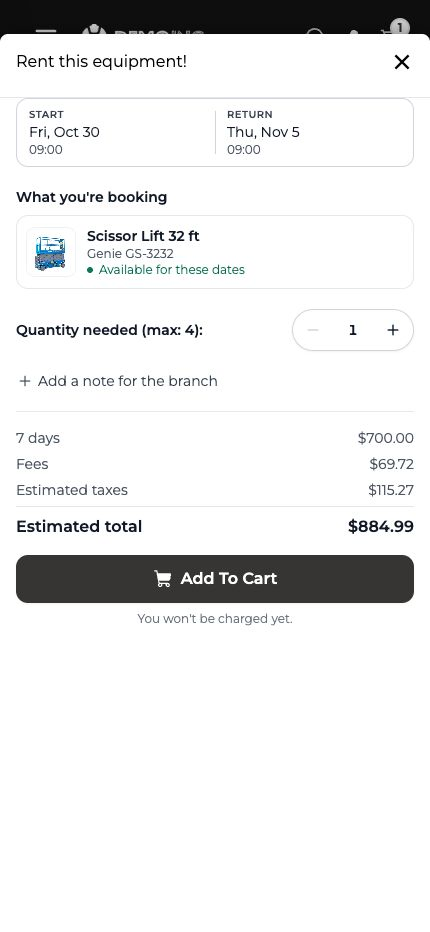
At the counter, you can check availability for the rental dates and branch, then open the machine’s record. Its inventory ID, barcode, serial number, branch, rental history and purchase record stay with its work orders, meter readings and photos.
A subrental stays separate from owned stock, with supplier dates and rates kept apart from customer dates and rates. That matters when a construction job needs another unit and the supplier's invoice must stay visible.
Heyquip also includes rentals, inventory and availability, yard preparation, sales and purchasing, service and repair, invoices, receivables, payments, a template e-commerce website and a customer portal. QuickBooks and Sage exports are manual files for review and import, not automatic synchronization. Accounting is integrated in the platform when enabled, so an export is not the whole accounting story.
Pricing: $599/month for up to 10 employees and one location, checked November 17, 2026. The subscription has a 12-month commitment. Payment processing is listed as 2.9% plus $0.30 per transaction, with hardware purchased through Stripe at Stripe's listed price. Taxes, processing fees, hardware and optional services are separate.
Best for: construction and event equipment rental shops that need rentals, sales, repairs, purchasing and customer records to stay together.
Limitation: more than 10 employees or multiple locations require a quote. The Heyquip Catalog is Beta, so confirm that it fits your storefront workflow before relying on it.
2. Point of Rental: broad rental operations
Point of Rental suits businesses that want a broad rental platform across heavy equipment, general tools, aerial equipment, event and tent operations, and other rental types. Its current pricing page describes cloud and on-premise deployment, inventory, invoicing, dispatch, accounting integrations, e-commerce, multi-currency support, mobile use and support for unlimited locations. These capabilities span different offerings. Confirm the edition: Elite and Essentials have different deployment options and feature scope.
The public page does not publish a dollar price. Instead, it asks for the rental business type, number of locations and region before a quote. That makes the product worth considering for a mature operation, but it also means you need a detailed quote to compare licence, users, modules, implementation, data migration, training and support.
Best for: established rental businesses with several locations, varied rental categories or a need for cloud and on-premise choices.
Limitation: pricing is not published. Ask whether the quoted edition includes the exact rental, service, e-commerce, accounting and mobile modules your team needs.
3. EZRentOut: equipment control and integrations
EZRentOut is a strong option for a fleet team that wants rental orders, maintenance, billing and connected tools on the same equipment record. Its features page documents serialized equipment, bulk inventory, recurring orders, partial returns, mobile barcode and QR scanning, work orders, inspections, GPS and telematics, customer portals, a rental webstore and custom roles.
The public documentation is specific about integrations. It lists QuickBooks, Sage, Xero, Stripe, Square, GPS and telematics connections, plus WordPress and Magento 2 options for storefront work. That gives an equipment-heavy shop a useful checklist for a demo. Ask which records sync in each direction and which connections are available in the plan you are quoted.
The product also publishes reporting for receivables, utilization, ROI and lost business. Those reports can help with purchasing decisions, but they are not a substitute for checking the formula and the accounting treatment behind each metric.
Best for: a construction or industrial rental team that needs equipment history, maintenance, reporting and integrations.
Pricing: EZRentOut lists Growth at $399 USD/month and Premium at $499 USD/month, billed annually. Enterprise is quoted separately. Premium adds features including QuickBooks integration, sub-renting, work orders and customer/business pricing. Enterprise lists custom integrations and GPS/telematics. Confirm the plan, location limits and implementation scope for your workflow.
4. Booqable: online-first rentals
Booqable is a practical choice when online booking is the centre of the business. Its pricing page lists Start at $35 USD/month, Grow at $87 USD/month and Scale at $187 USD/month with monthly billing, checked November 17, 2026. With annual billing, the displayed monthly equivalents are $29, $69 and $149 USD. Compare the same billing term across vendors.
The core workflow covers orders, inventory, quotes, contracts, invoices, real-time availability, product bundles, customer records and online booking. The feature list also documents bulk and individually managed items, temporary stock for subrentals, downtime scheduling, security deposits, e-signatures, exports, API access and Xero.
The add-on structure deserves attention. The website builder costs an additional $24 USD/month with monthly billing, or $19/month with annual billing. Mobile POS is $12 USD/user/month with monthly billing, or $9 with annual billing. Check the current plan and add-on requirements for scanning and deliveries before comparing the total.
A small shop should price the actual workflow rather than compare only the base subscription. Grow and Scale add capabilities beyond Start, so ask which tier includes the features your team will use.
Best for: online-first event, tool or equipment rental businesses that want a booking page, embedded checkout and clear monthly tiers.
Limitation: several useful operations features are add-ons or higher-tier features. If your business needs deep workshop jobs, service history and heavy-equipment branch operations, ask for a workflow demonstration before choosing it.
5. Quipli: independent construction and tool rental shops
Quipli targets independent rental companies in North America. Its pricing page lists Core at $6,000 USD per year per location, checked November 17, 2026, with unlimited users. Plus is listed at $10,000 USD per year per location and adds Quinn and CRM capabilities. Confirm the current feature scope and implementation terms for the plan you choose.
The platform covers booking, scheduling, inventory, point of sale, service, repair, dispatch, invoicing, payments, online storefronts, customer portals and QuickBooks synchronization. The vendor says it can track individual units or bulk quantities and show availability by date. Onboarding and support are included; confirm training scope, including any on-site work, in the proposal.
The fit limitation is unusually clear on the official page. Quipli says it works best for heavy construction equipment and general tool rental companies.
It also says it is not currently a good fit for event, audio/visual, trailer, dumpster, golf cart, boat, ATV and several other categories. An event shop should not treat its general rental feature list as proof of fit.
Best for: an independent construction or general tool rental business that prefers annual, per-location pricing with users included.
Limitation: category fit is narrower than the roster of features suggests. The public price is in USD and is per location, so Canadian buyers should confirm taxes, payment costs and any multi-location rate.
6. Texada: heavy-equipment depth and field service
Texada is built for heavy-equipment rental businesses that want rental management, field service, e-commerce, payments, analytics and damage workflows connected. Its official rental page describes inventory management with visibility across locations, mobile access to job details and work orders, branded online rental stores, inspections and analytics.
This is the option to investigate when a rental shop also runs technicians and field work at scale. The page separates rental, field service, e-commerce, damage detection, analytics and payments into solution areas, so implementation may involve a wider product conversation than a small shop expects from a single subscription.
Best for: heavy-equipment businesses with a serious field service operation, multiple locations or a need to connect rental and e-commerce workflows.
Limitation: the public rental page does not publish a starting price. Ask for the edition and module map, data migration plan, training scope, mobile requirements and integration costs in writing.
Which equipment rental software should you choose?
Include Heyquip in your shortlist if your team wants rental, sales, fleet and inventory, repairs, invoicing, payments and a storefront in one connected system, and its $599/month plan fits your team and location count. Confirm currency and the 12-month commitment. Evaluate Point of Rental or Texada when deployment options, heavy-equipment workflows or field service lead your requirements.
Choose EZRentOut when equipment history, maintenance, reporting and integrations lead the decision. Choose Booqable when online booking and visible monthly tiers matter most. Choose Quipli when you run an independent construction or general tool rental shop and per-location annual pricing fits.
Before you sign, run one real rental through each demo: quote, reserve, prepare, deliver, return, inspect, repair, invoice, collect payment and post the accounting entry. Ask who owns the data cleanup, what happens to historical equipment and customer records, and which features are included in your quoted edition.
FAQ
What is the best equipment rental software for a small shop?
For a small shop, compare the work you need covered and the total cost. Heyquip is one option for connected rentals, sales, service and office records, at a published $599/month for up to 10 employees and one location with a 12-month commitment. Confirm currency. Booqable offers lower entry prices for an online-first workflow. Neither starting price alone establishes which is the better fit.
Which equipment rental software has public pricing?
Heyquip, EZRentOut, Booqable and Quipli publish prices. EZRentOut’s displayed monthly rates are billed annually; Booqable shows different monthly and annual rates; Quipli prices annually per location. Point of Rental’s pricing page and Texada’s rental page do not show a starting amount. Compare users, branches, billing commitment, onboarding, add-ons and payment fees in writing.
Is equipment rental software useful for event rentals?
Yes, but the fit depends on the workflow. Point of Rental lists event and tent rental as a supported category, while Booqable focuses on online booking and Quipli says event rental is not currently a good fit. Ask each vendor to demonstrate packages, delivery, setup, returns and damage handling.
Which systems should a Canadian rental shop compare if it also repairs equipment?
Heyquip, EZRentOut, Quipli and Texada all describe service, repair or work-order capabilities on their official pages. Booqable documents downtime scheduling, but its public feature pages show less detail about a full workshop workflow, so ask for a service demonstration if repairs are central to your business.
Give each vendor the same counter job. A contractor brings in a broken plate compactor and needs a rental until Friday. Ask the counter to find a replacement at your branch for those dates. Have the mechanic open a work order on the contractor’s machine, add a belt and record 45 minutes of labour. Can the office invoice the billable parts and labour and show what the customer still owes? Use the demo checklist to record what each vendor can show.
Does equipment rental software replace accounting software?
Not always. Heyquip offers integrated accounting when enabled. For QuickBooks or Sage, someone on your team reviews and imports the export file manually. EZRentOut documents a QuickBooks integration and Booqable lists Xero. Confirm the exact sync or export direction, tax handling, invoice ownership and reconciliation process before treating any connection as a replacement for your accounting system.
What should I ask about migration?
Ask how the vendor imports equipment, serial numbers, customers, open contracts, pricing, service history and accounting balances. Confirm who cleans the files, who checks the import, what training is included and when your team can run a test rental before the switch.
Sources & References
EZRentOut pricing, checked November 17, 2026: annual billing, Growth and Premium prices and plan scope.
- Heyquip pricing, checked November 17, 2026: public price, payment terms, included modules and support.
- Heyquip fleet and inventory, checked November 17, 2026: availability, serialized equipment, branches, subrentals and work history.
- Point of Rental pricing, checked November 17, 2026: tailored pricing and deployment scope.
- EZRentOut features, checked November 17, 2026: rental orders, equipment, service, webstore and integrations.
- Booqable pricing, checked November 17, 2026: plan prices, add-ons and feature limits.
- Quipli pricing, checked November 17, 2026: per-location pricing, included users and category fit.
- Texada rental solutions, checked November 17, 2026: rental, field service, e-commerce, inspections, analytics and payments.